
This series is designed specifically for current parents navigating conflict with their child’s independent school. For prospective parents, we suggest exploring alternative options before committing to a school where conflict is already present.
While the admissions team typically has little to do with the experience after a place is secured and lessons begin, we often hear from parents that early concerns during the admissions process can echo throughout their child’s time at the school. Whether this is because both the admissions team and school staff ultimately answer to the same leadership, or because families who had negative first experiences are more likely to notice issues later, we cannot say.
We would only suggest that where families are struggling to have their concerns addressed during the admissions process, when schools are actively recruiting, the experience is unlikely to improve once a commitment has been made.
We developed this series in response to an increasing number of requests from parents seeking advice on how to resolve issues with their schools. As fees rise, so do parental expectations, especially when faced with troubling reports of bullying, mental health crises, or even assault within some of the UK’s most esteemed institutions. The stakes are high—both financially and emotionally—and understanding how to handle school conflict is more important than ever for families.
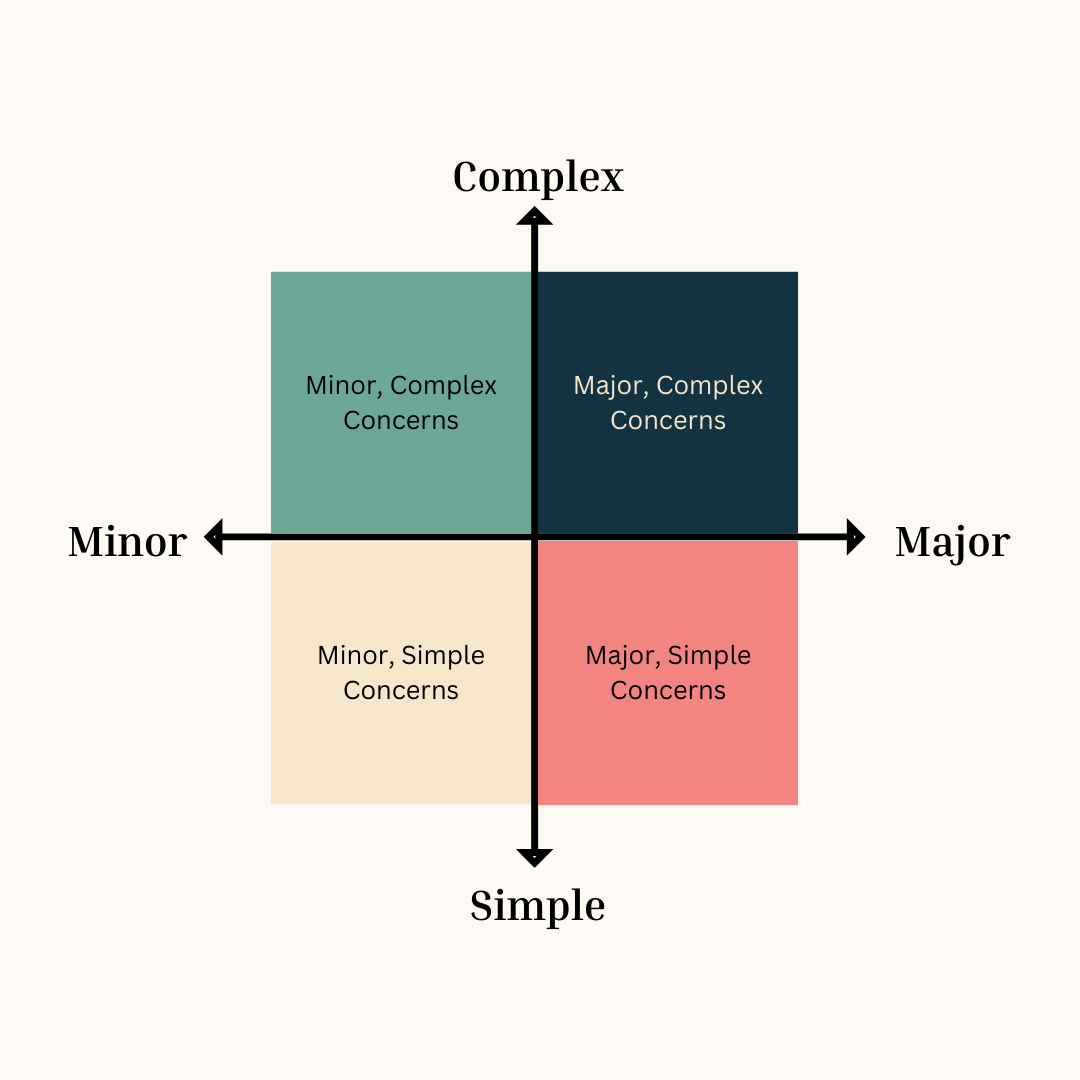
The first step is to assess the severity and complexity of any concern. The chart below offers a framework:
- X-Axis: Minor → Major
- Y-Axis: Simple → Complex
Top-right quadrant (major and complex): Significant, multifaceted concerns like pervasive bullying or mental health crises affecting various aspects of school life.
Bottom-right quadrant (major and simple): Instances where a single event has a significant impact, such as a one-time incident of assault.
Bottom-left quadrant (minor and simple): Straightforward, isolated problems, such as a miscommunication between a parent and a teacher or a concerning but not severe, one-off incident.
Top-left quadrant (major and simple): Smaller but still complex issues, such as ongoing communication failures across departments.
The best schools will have systems in place to address concerns in all quadrants and will support students effectively. However, many schools, even those with the best intentions, can struggle to identify and resolve problems in a timely manner. Some schools, unfortunately, may even actively minimise or deny parental concerns, which can worsen the issue, erode trust, and place students in very real danger.
Identify Your Position
The first step is to identify where your concern sits on this graph. Be as objective as possible. Is it a minor, simple issue? Or is it a major, complex concern requiring more immediate attention and action? Identifying a concern as being within one quadrant or another is not about minimising the impact or potential impact, but about identifying the most effective way to address it.
Next, consider where you want the concern to be. Ideally, the concern would disappear from the graph completely, but in many cases that will not be a realistic option. Are there actions the school could take, or things you can do in partnership with the school, to shift the concern to a more manageable position? Consider also whether you can realistically expect your current school to work with you to close that gap, given the resources and personnel involved.
A concern’s positioning can change quickly or shift gradually over a period of time. Something that starts as a minor, simple concern can become major and/or complex, either because the situation evolves or it combines or links to another concern. In some cases families may find multiple concerns are linked, with underlying themes.
If you’re unsure about how to map concerns, we recommend starting with Addressing Minor, Simple Concerns first, then Addressing Minor, Complex Concerns, then Major, Simple, Concerns, and finally, Major, Complex Concerns. Alternatively, you might find your concern falls within a specific category such as SEN/AEN, Discrimination, Mental Health Support, Behaviour and Discipline, Bullying, Academic, or Sport.
Leave a Reply